
What Is an Acidity Regulator? Meaning, Uses, Examples and Safety Explained

 23 Jun 2026
 11 Min Read
 Views
Views

Summary :
This article explains what acidity regulators are and why food manufacturers add them to packaged products. Readers will learn about common examples like citric acid and lactic acid, how to spot them on ingredient labels, and whether they are safe to consume. By the end, you’ll have the knowledge to read food labels more confidently and make better-informed food choices.
Have you ever turned a packet of biscuits, a fizzy drink, or a fruit juice carton around and noticed the words "acidity regulator" in the ingredient list? You are definitely not alone. Most people have seen these two words but have little idea what they actually mean or why they are there.
Acidity regulators are among the most widely used food additives in packaged and processed foods. They quietly do important work in everything from your favourite cola to your morning yoghurt. Understanding what they are, what they do, and whether they are safe can help you make smarter choices every time you shop.
This article breaks it all down in simple, clear language — no food science degree required.
What Is an Acidity Regulator?
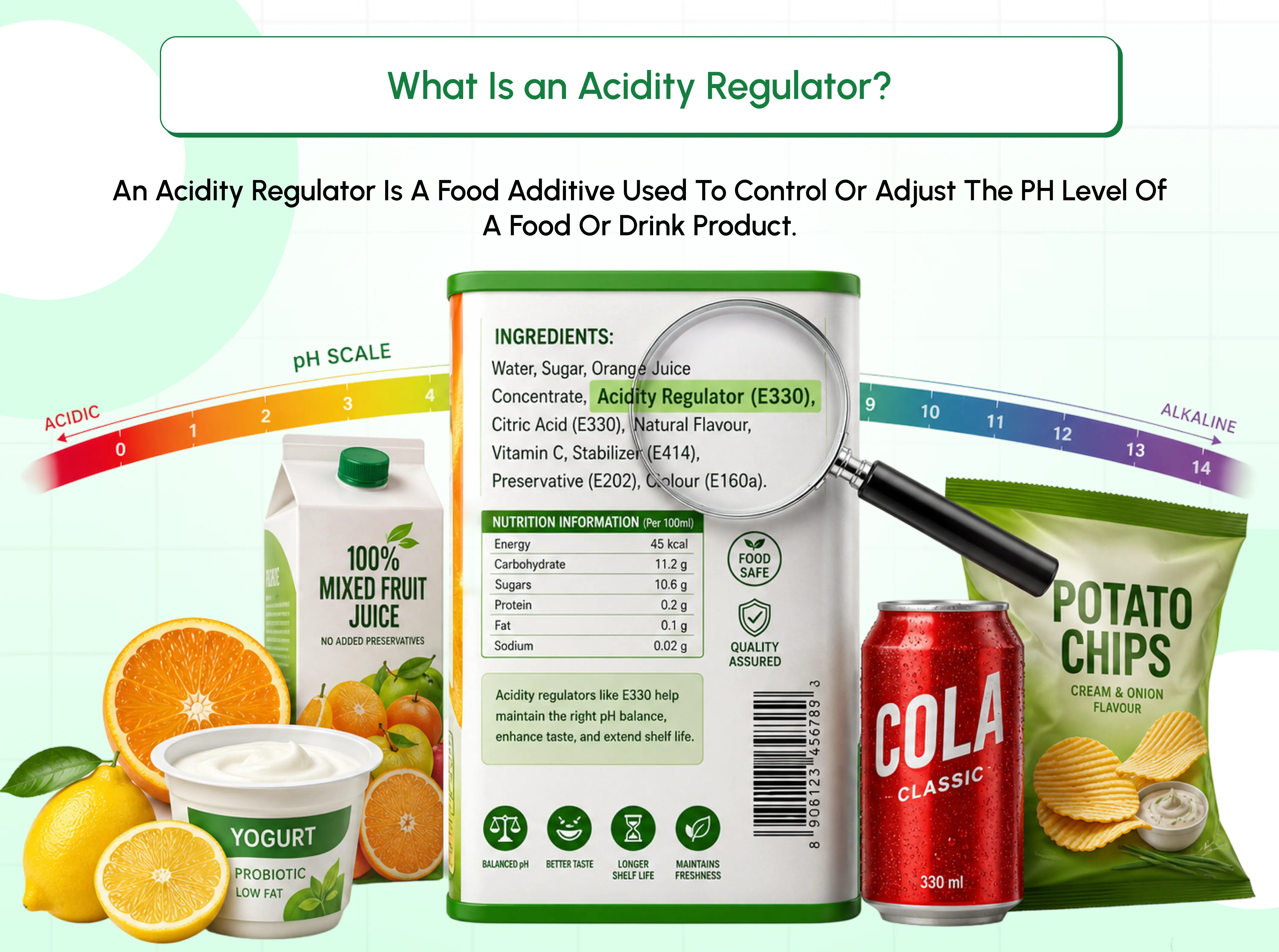
An acidity regulator is a food additive used to control or adjust the pH level of a food or drink product. In plain terms, pH is a measure of how acidic or alkaline something is. Water sits in the middle at pH 7, while lemon juice is acidic at around pH 2 and baking soda is alkaline at around pH 9.
When manufacturers make packaged food, even small changes in pH can affect how the product tastes, looks, feels, and how long it stays fresh. Acidity regulators are used to keep pH levels consistent throughout the product's shelf life.
Think of it this way: if you have ever noticed how a freshly cut apple turns brown within minutes, that is oxidation caused by a change in chemical balance. Acidity regulators work in a similar way to slow or prevent these kinds of changes in packaged food.
They can be acids, bases, or buffering agents, each serving a slightly different function depending on the product.
Why Are Acidity Regulators Used in Food?
1. To maintain product stability
Food products go through a lot between the factory floor and your kitchen shelf. Temperature changes, light exposure, and time can all trigger chemical reactions that alter a product's colour, texture, or consistency. Acidity regulators help maintain the right chemical balance, keeping the product stable and consistent from batch to batch.
2. To improve taste and flavour balance
Acidity plays a major role in how food tastes. A drink that is too alkaline can taste flat or soapy. One that is too acidic can taste harsh or sharp. Acidity regulators help manufacturers strike the right balance, which is why a well-formulated fizzy drink always tastes the same whether you buy it today or six months from now.
3. To extend shelf life
Controlling pH is one of the oldest and most reliable methods of preserving food. Most bacteria and molds that spoil food thrive in certain pH ranges. By adjusting the acidity, manufacturers can create an environment where these microorganisms struggle to grow, helping products stay fresh for longer.
4. To support food safety
Beyond flavour and shelf life, acidity control is an important food safety tool. Pathogens like certain strains of bacteria are inhibited at lower pH levels. This is why fermented foods like pickles and yoghurt, which are naturally acidic, have been safely consumed for thousands of years.
| Purpose | Benefit |
|---|---|
| pH control | Maintains consistent product quality |
| Taste balancing | Ensures pleasant, predictable flavour |
| Shelf life extension | Keeps products fresh for longer |
| Product stability | Prevents unwanted changes in colour, texture, or consistency |
| Food safety support | Inhibits harmful microbial growth |
Common Examples of Acidity Regulators
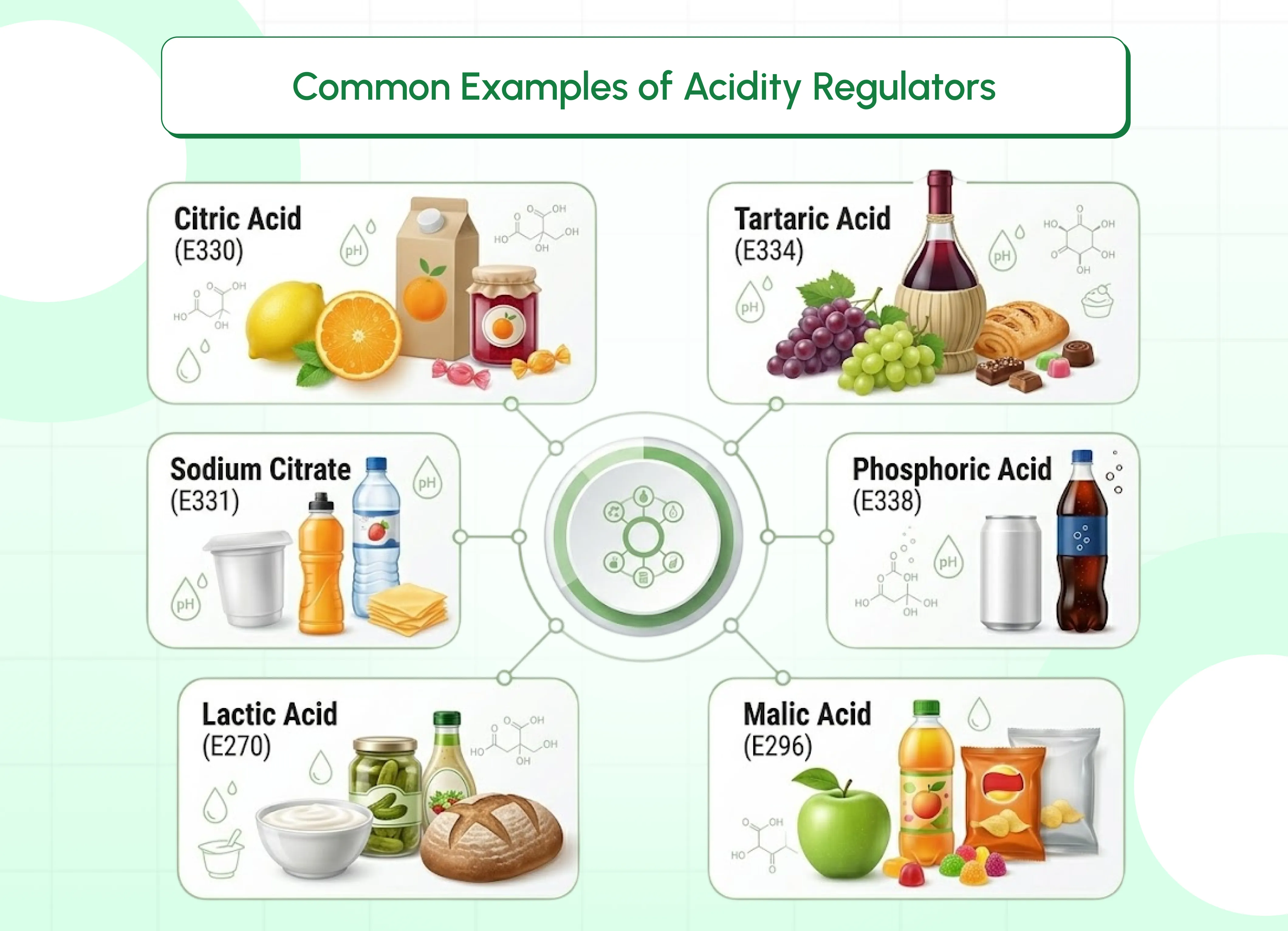
There are dozens of acidity regulators approved for use in food, but a handful appear most frequently on ingredient labels.
| Acidity Regulator | E Number | Common Uses |
|---|---|---|
| Citric Acid | E330 | Soft drinks, juices, confectionery, jams |
| Sodium Citrate | E331 | Dairy products, beverages, processed cheese |
| Lactic Acid | E270 | Yoghurt, pickles, salad dressings, bread |
| Malic Acid | E296 | Sweets, fruit-flavoured drinks, snacks |
| Phosphoric Acid | E338 | Colas and dark soft drinks |
| Tartaric Acid | E334 | Wine, baked goods, confectionery |
1. Citric acid (E330)
Citric acid is arguably the most commonly used acidity regulator in the world. It occurs naturally in citrus fruits like lemons and limes, which is why it has such a familiar, tangy taste. In packaged food, it is added to soft drinks, fruit juices, sweets, jams, and even some savoury snacks to add a slight sharpness and help preserve the product.
2. Sodium citrate (E331)
Sodium citrate is the sodium salt of citric acid. It is used not just as an acidity regulator but also as a buffering agent, meaning it helps prevent sharp fluctuations in pH. You will often find it in sports drinks, flavoured water, dairy-based beverages, and processed cheese products.
3. Lactic acid (E270)
Lactic acid forms naturally during fermentation, which is why yoghurt, buttermilk, and pickled vegetables have that characteristic tangy flavour. In packaged food production, it is added to salad dressings, breads, and processed dairy products to control acidity and extend freshness.
4. Phosphoric acid (E338)
Phosphoric acid is widely used in cola-based soft drinks and gives them their sharp, slightly biting flavour. It is one of the more discussed acidity regulators because of ongoing conversations about its effect on dental enamel with high consumption over time. Moderate, occasional consumption is considered safe by food regulators globally.
Which Foods Commonly Contain Acidity Regulators?
Acidity regulators appear in a surprisingly wide range of everyday products. Some of the most common include:
- Soft drinks and colas — phosphoric acid and citric acid are standard ingredients.
- Fruit juices and squashes — citric acid and malic acid adjust tartness and preserve flavour.
- Packaged snacks — acidity regulators help balance flavour coatings on crisps and puffed snacks.
- Dairy products — lactic acid and sodium citrate appear in yoghurts, flavoured milk, and processed cheese.
- Sauces and condiments — vinegar-based products naturally contain acetic acid; others use citric or lactic acid.
- Confectionery — sour sweets and gummies frequently use citric and malic acid for their sharp flavour.
- Processed and ready-to-eat foods — pH control helps extend shelf life and maintain texture.
If you regularly eat packaged food, chances are you consume acidity regulators almost every day.
Are Acidity Regulators Safe to Consume?
This is one of the most common questions consumers ask, and the straightforward answer is yes approved acidity regulators are considered safe for general consumption.
Before any food additive can be used in packaged food, it must go through rigorous safety assessments by food safety authorities. In India, the Food Safety and Standards Authority of India (FSSAI) regulates which additives are permitted and in what quantities. Similar bodies operate globally, including the European Food Safety Authority (EFSA) and the US Food and Drug Administration (FDA).
These organisations review scientific evidence on toxicity, acceptable daily intake levels, and long-term health effects before approving any additive. Acidity regulators that appear on approved lists have passed these evaluations.
That said, balance matters. Consuming very large quantities of any single additive over a long period of time is not advisable. Most people who eat a varied diet will consume acidity regulators well within safe limits.
Key takeaway:
Approved acidity regulators used within permitted levels are generally considered safe for most people. They are not a cause for alarm when you see them on a label. The broader quality of your overall diet matters far more than the presence of a single approved additive in one product.
Acidity Regulators vs Preservatives: What Is the Difference?
Many consumers confuse acidity regulators with preservatives because both can extend shelf life. They are, however, different types of additives with different primary functions.
| Feature | Acidity Regulators | Preservatives |
|---|---|---|
| Main purpose | Control pH levels | Prevent microbial growth and spoilage |
| Function | Adjust acidity or alkalinity | Inhibit bacteria, mould, or yeast directly |
| Impact on flavour | Can significantly affect taste | Minimal direct impact on flavour |
| Shelf life role | Indirect, through pH control | Direct, primary function |
| Examples | Citric acid, lactic acid, malic acid | Sodium benzoate, potassium sorbate, sulphites |
While acidity regulators can create an environment where spoilage is less likely, their primary job is pH management, not direct preservation. Preservatives, on the other hand, are specifically designed to stop or slow the growth of microorganisms.
How to Identify Acidity Regulators on Food Labels
Once you know what to look for, spotting acidity regulators on ingredient labels becomes straightforward.
Manufacturers can list acidity regulators in a few different ways:
- By functional category name followed by the additive name — for example, Acidity regulator (citric acid).
- By functional category name followed by the E number — for example, Acidity regulator (E330).
- By additive name only — for example, Citric acid.
Here is what a sample ingredient label might look like:
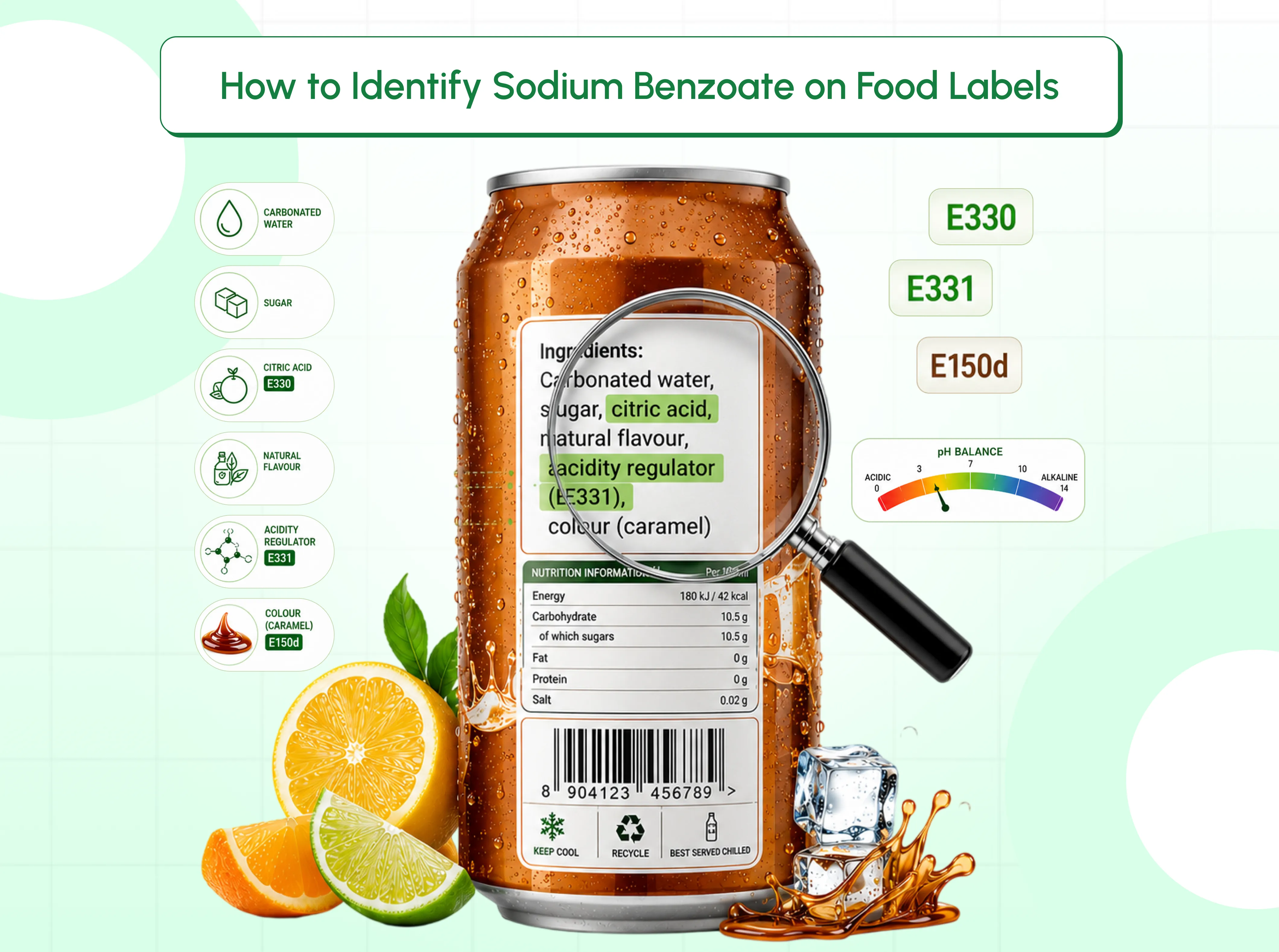
Ingredients: Carbonated water, sugar, citric acid, natural flavour, acidity regulator (E331), colour (caramel).
The functional category name "acidity regulator" tells you what the ingredient does. The name or E number in brackets tells you what it actually is.
Understanding how to read food labels properly takes a little practice, but it is one of the most empowering skills you can develop as a consumer. If you want to go deeper, our guide on nutrition labels walks you through how to decode everything on the panel, from serving sizes to additive listings.
Should You Avoid Foods That Contain Acidity Regulators?
Not necessarily. The presence of an acidity regulator on an ingredient label does not automatically make a product unhealthy.
A soft drink that contains citric acid alongside large amounts of sugar and artificial colours is quite different from a plain yoghurt that contains lactic acid as a natural byproduct of fermentation. Both technically contain acidity regulators, but their overall nutritional profiles are completely different.
When evaluating a packaged product, it is far more useful to look at the full ingredient list and nutritional information rather than focusing on a single additive. Ask yourself: how much sugar does this product contain? Are the first few ingredients whole foods or highly processed ones? What does the overall nutrient breakdown look like?
Knowing how to spot ingredient red flags in a product is a much more practical approach than avoiding every item that lists an approved additive. For a deeper look at which additives are genuinely worth being cautious about, our article on food additives to avoid gives you a clear, evidence-based breakdown.
How FactsScan Helps You Understand Food Ingredients
Reading and interpreting ingredient labels can feel overwhelming, especially when a single product might list a dozen additives using unfamiliar names or E numbers. This is exactly the problem FactsScan is built to solve.
With FactsScan, you can simply scan the barcode of any packaged food product and instantly get a clear breakdown of what is inside it. The app analyses the ingredient list, explains additives in plain language, flags anything worth paying attention to, and gives the product a score based on its overall nutritional profile. There is no need to cross-reference ingredient lists or look up E numbers manually.
The FactsScan scoring system is designed to simplify food decisions without oversimplifying the science. Whether you are trying to eat healthier, manage a specific dietary need, or simply understand what you are putting into your body, FactsScan makes the process fast and approachable.
Conclusion
Acidity regulators are a standard part of modern food production, and for good reason. They help manufacturers maintain consistent flavour, texture, and safety across millions of products. The next time you see "acidity regulator" on a label, you now know it is not something to immediately worry about — it simply means the manufacturer has used an approved ingredient to control the product's pH.
That said, informed consumers are always better placed to make good choices. Understanding what is in your food, reading ingredient lists carefully, and knowing how to evaluate a product's overall nutritional quality matters far more than fixating on any single additive.
Make a habit of checking ingredient labels before you buy. The information is there — you just need to know how to read it.
Understanding food ingredients should not be complicated. FactsScan helps you instantly scan packaged foods, understand additives, analyse ingredients, and make smarter food choices — all in seconds.
Download FactsScan today and start making more informed decisions every time you shop.
Frequently Asked Questions (FAQs)
An acidity regulator is a food additive used to control, adjust, or maintain the pH level of a food or drink product. It helps ensure consistent taste, texture, stability, and shelf life.
Yes, citric acid (E330) is one of the most widely used acidity regulators in food and beverages. It occurs naturally in citrus fruits and is added to a wide range of products including soft drinks, juices, sweets, and preserves.
Approved acidity regulators are not harmful when consumed within the levels permitted by food safety authorities. They undergo extensive safety testing before being approved for use in food. As with anything, very high consumption of any single substance over a long period is not recommended.
They are added to control pH, balance flavour, maintain product consistency, support food safety, and help extend shelf life.
E330 is the European food additive code for citric acid. It is a widely used acidity regulator derived from citrus fruits and is considered safe for consumption.
Both. Some acidity regulators, like citric acid and lactic acid, occur naturally in fruits and fermented foods. Others are synthesised for commercial use. Whether natural or synthetic, all approved additives undergo the same safety evaluation process.
Acidity regulators are found in soft drinks, fruit juices, yoghurt, pickles, sauces, confectionery, packaged snacks, processed cheese, and many other packaged and processed food products.
Look for the words "acidity regulator" followed by either the additive's name or its E number in brackets. Common examples include "acidity regulator (citric acid)" or "acidity regulator (E330)".
Ready to make Healthier Choices?
Download FactsScan now from the Google Play Store and App Store and take charge of your food choices.





Sweety Patel

Author

Sweety Patel, founder of FactsScan, has over 14 years of experience in the development industry, where she has successfully created multiple applications. Driven by her passion for food safety and health, she launched FactsScan to provide consumers with a reliable solution to understand what they’re eating, its nutritional value, and better alternatives. With extensive research in food and nutrition, Sweety is committed to empowering people to make informed food choices for a healthier lifestyle.
Recent Articles
Synthetic Food Colour 110: Side Effects and How It Is Used
Synthetic Food Colour 110 (Sunset Yellow FCF) is a widely used artificial dye that gives many packaged foods their bright orange-yellow look, from chips to soft drinks. While it’s approved within safe limits, it’s still important to be aware of such additives. Understanding what’s in your food helps you make smarter, more informed choices for yourself and your family.

Artificial Colors in Food: Are They Safe?
Artificial colors are added to many foods to make them look bright and attractive. In this blog, we explain if these colors are safe, their possible health effects, and what you should check before buying food.
All You Need to Know About Food Dyes: Harmful vs Harmless
Food dyes are synthetic or natural colorants added to enhance food appearance and attractiveness. While artificial food dyes may pose health risks like hyperactivity in children and allergies, natural alternatives from plants and minerals offer safer options. Understanding labels and choosing wisely helps protect your family's health.