
What Does ‘No Added Sugar’ Really Mean?

 30 Jun 2026
 10 Min Read
 Views
Views

Summary :
Many shoppers assume “No Added Sugar” means a product contains no sugar at all but that is not the full story. This article explains the difference between added and naturally occurring sugars, decodes common label claims, and shows you how to spot hidden sugars in everyday packaged foods. By the end, you will be equipped to read food labels with confidence and make genuinely healthier choices.
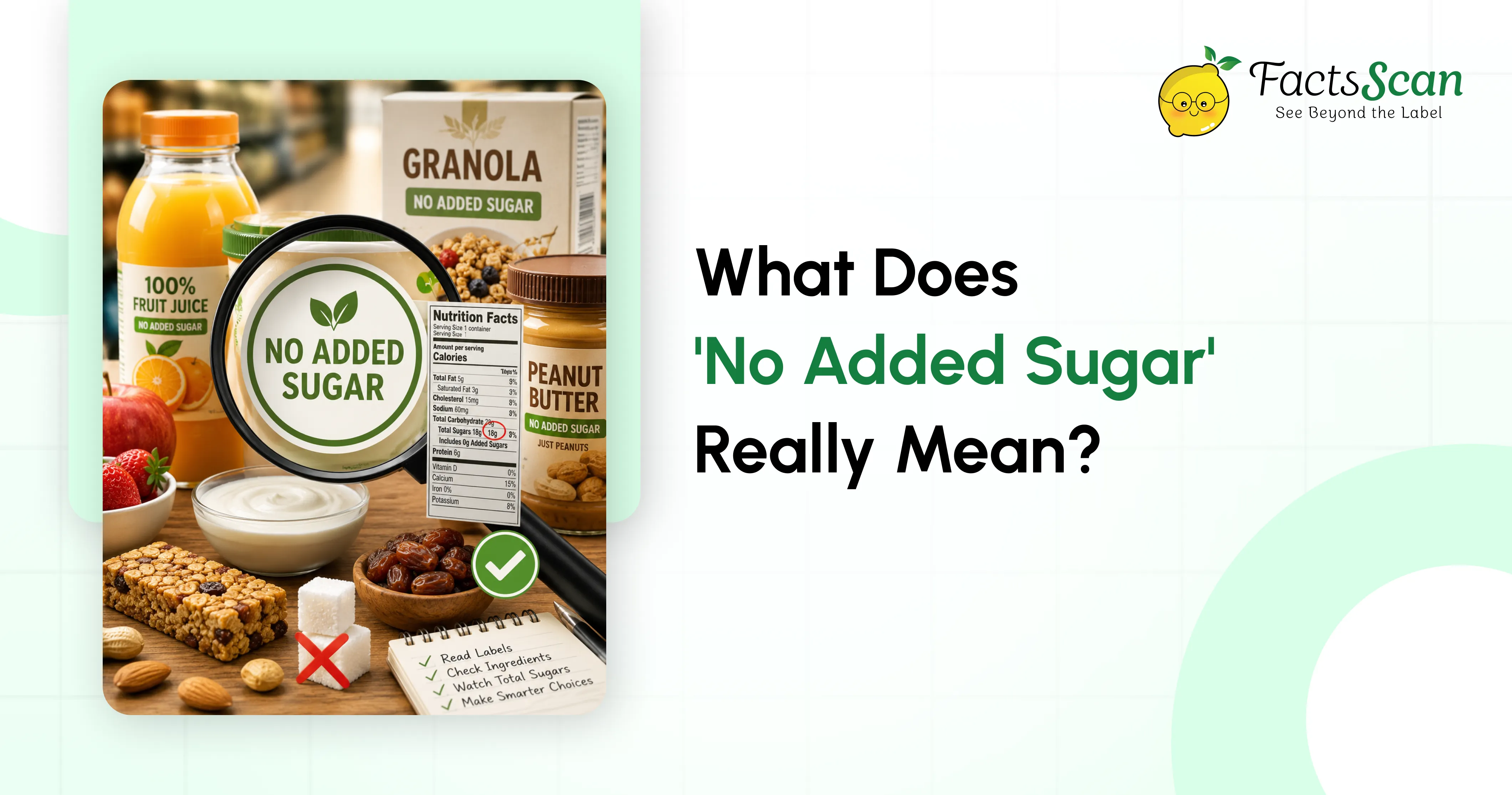
Walk through any supermarket aisle and you will see it everywhere. “No Added Sugar” printed boldly on juice cartons, cereal boxes, snack bars, and yoghurts. It sounds reassuringly healthy. But here is the thing: no added sugar does not mean sugar free, and it certainly does not always mean low in sugar.
Food packaging claims can be genuinely confusing, and that confusion can lead to choices that do not quite match your health goals. Understanding what these labels actually mean puts the power back in your hands.
In this article, you will learn the real no added sugar meaning, how it differs from sugar free, what natural sugars mean for your body, which common products carry this label, and how to spot hidden sugars in packaged foods.
What Does 'No Added Sugar' Really Mean?
“No Added Sugar” is a regulated food label claim. It means the manufacturer has not added any sugar or sugar containing ingredients during processing or packaging.
What manufacturers cannot add under this claim:
- White sugar, brown sugar, or raw sugar
- Corn syrup or high fructose corn syrup
- Honey, maple syrup, or agave nectar
- Fruit juice concentrates used as sweeteners
- Any ingredient added specifically to sweeten the product
However, the product can still contain naturally occurring sugars that are present in the food’s original ingredients before any processing.
Practical examples:
- Fruit juice made from whole fruits contains fructose naturally and no sugar needs to be added
- Unsweetened yoghurt contains lactose, the natural sugar found in milk
- Dried fruit like raisins or dates are intensely sweet because drying concentrates their natural fruit sugars
- Applesauce made from apples alone will taste sweet from the fruit’s own sugars
So the no added sugar label meaning is simple: nothing extra was put in, but what was already there can still add up.
Does No Added Sugar Mean Sugar Free?
No, and this is one of the most common misconceptions on food packaging. These are legally distinct claims.
| Claim | Meaning |
|---|---|
| No Added Sugar | No sugar or sweetener was added during manufacturing. Natural sugars may still be present. |
| Sugar Free | Contains less than 0.5g of sugar per serving. Both added and natural sugars must be negligible. |
| Reduced Sugar | Contains at least 25% less sugar than the regular version of the same product. |
| Unsweetened | No sweeteners, natural or artificial, were added. Natural sugars from ingredients may still be present. |
A glass of pure orange juice can honestly carry a “No Added Sugar” label while containing 20 to 25g of sugar per 250ml serving, all from the fruit itself. A sugar free beverage, by contrast, must contain almost no sugar at all.
The bottom line: no added sugar vs sugar free is a meaningful difference that shoppers often overlook.
Natural Sugar vs Added Sugar
Understanding this distinction is key to reading any food label intelligently.
Naturally occurring sugars are found in whole, unprocessed foods. They come packaged with fibre, water, vitamins, and minerals that slow digestion and provide nutritional value.
Added sugars are introduced during food manufacturing to enhance sweetness, flavour, or shelf life. They deliver calories with little or no nutritional benefit.
| Naturally Occurring Sugar | Added Sugar |
|---|---|
| Milk (lactose) | White sugar |
| Fruits (fructose) | Corn syrup |
| Dates | Honey |
| Yoghurt (lactose) | Maltose |
Here is an important nuance: your body processes sugar similarly regardless of its source. Once digested, fructose from a mango and fructose from a soft drink follow similar metabolic pathways. The difference is that whole foods come with fibre that slows sugar absorption, while a glass of juice or a sweetened snack delivers sugar rapidly.
Portion control matters just as much as the source. A handful of dates is nutritious; a large bowlful is still a significant sugar load.
Common Foods Labelled as 'No Added Sugar'
1. Fruit Juices
Pure fruit juices are among the most misunderstood “No Added Sugar” products. Even 100% juice with no added sugar contains substantial fructose from the fruit. Additionally, juicing removes most of the fibre that would normally slow sugar absorption.
2. Breakfast Cereals
Many cereals made from grains, dried fruits, or nuts carry this claim. Check the nutrition panel carefully because a serving can still contain 8 to 15g of total sugar from dried fruit or naturally sweet grains.
3. Peanut Butter
Natural peanut butter often carries this label legitimately. Peanuts contain very little natural sugar, so the total sugar in natural peanut butter is usually low. Compare this with regular peanut butter, which often has sugar or corn syrup added.
4. Flavoured Yoghurt
This is a category where the label can mislead. Some flavoured yoghurts use fruit purée or fruit concentrate, not refined sugar, to sweeten the product. They can still carry a “No Added Sugar” label while containing 15 to 20g of total sugar per serving.
5. Snack Bars
Many health bars are sweetened with dates, figs, or raisins. These are whole food ingredients, so technically no sugar is added. Yet a single bar might contain 18 to 22g of total sugar.
6. Dried Fruits
Drying fruit removes water and concentrates everything, including sugar. Raisins, dried mango, and dried cranberries when unsweetened all carry natural sugars in concentrated form. Always check the serving size listed, as it is often small.
In every category above, reading the ingredient list and nutrition panel is essential, not just the front of pack claim.
Why Some No Added Sugar Products Still Taste Sweet
If no sugar was added, why does a product taste so sweet? The answer lies in ingredients that are technically natural but function like sweeteners.
Common naturally sweet ingredients used in no added sugar products:
- Fruit concentrates such as apple, grape, and pear concentrate
- Fruit purée used in sauces, bars, and yoghurts
- Dates and date paste, a dense source of fructose and glucose
- Raisins, intensely sweet in small quantities
- Apple concentrate, widely used in natural beverages and snacks
Example ingredient list on a snack bar:
Apples, Date Paste, Raisins, Natural Flavouring
No white sugar appears. The label says “No Added Sugar.” Yet the product is sweet because dates and raisins are naturally high in sugar. This is entirely legal and not deceptive by regulation, but it is worth understanding as a shopper.
Is No Added Sugar Always Healthy?
Not automatically. A “No Added Sugar” label tells you one thing about one ingredient. It says nothing about:
- Total calories, which can still be high
- Total sugar content, which can still be significant
- Saturated fat, common in biscuits, snack bars, and nut based products
- Sodium, present in many savoury no added sugar products
- Additives and preservatives, which are unrelated to sugar content
| Product | No Added Sugar | Typical Total Sugar Content |
|---|---|---|
| Fruit juice (250ml) | Yes | 20 to 25g |
| Digestive style biscuit | Yes (some varieties) | 8 to 12g per 2 biscuits |
| Date and nut snack bar | Yes | 18 to 22g |
Is no added sugar healthy? It can be a useful indicator, but only when combined with a full read of the nutrition panel and ingredient list. No single label claim tells the whole story.
How to Spot Hidden Sugars in Packaged Foods
Sugar goes by more than 60 different names on ingredient lists. If you want to know what to actually look for, this guide on hidden sugar names is a good place to start.
When checking a packaged food, look at:
- The ingredient list — ingredients are listed in order of weight, so if a sugar appears in the first three ingredients, it is present in significant quantity
- The nutrition panel — find the Total Sugars row and note the amount per 100g and per serving
- The serving size — a product might show 5g sugar per serving, but if the serving size is 30g and you eat 90g, you are consuming 15g
- Multiple sugar names in one product — manufacturers sometimes use several different sugars so that none appears high on the ingredient list individually
If you want to go further, this detailed look at hidden sugar in food packets covers how sugar is disguised across different product categories.
How to Read Sugar Information on Food Labels
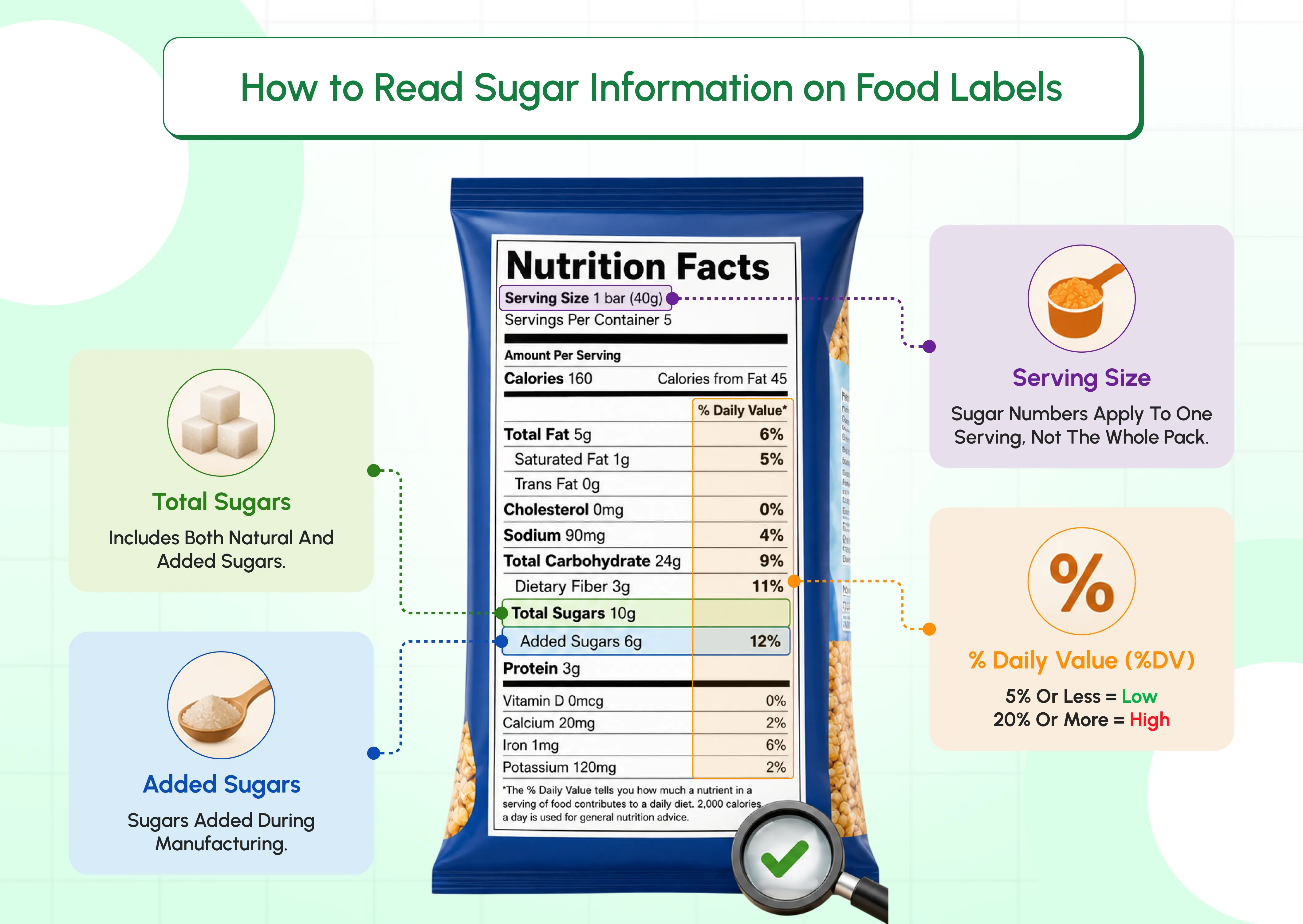
Once you get comfortable with sugar, it helps to understand the full nutrition label, not just one row of it. This breakdown of food labels covers everything from fat to fibre in plain language.
For sugar specifically, here is what to focus on:
- Total Sugars — includes both naturally occurring and added sugars combined
- Added Sugars (where listed separately) — shows only sugars introduced during manufacturing
- % Daily Value — where listed, 5% or less per serving is considered low and 20% or more is considered high
A quick note on serving size: the numbers on every label refer to the listed portion, not the whole packet. Most people eat more than one serving without realising it, which can easily double or triple the sugar they are actually consuming.
A practical habit: flip every packaged product over before you buy it. Spend 15 seconds on the nutrition panel. You will quickly develop a feel for what is genuinely low in sugar and what is not.
How FactsScan Helps You Identify Hidden Sugars
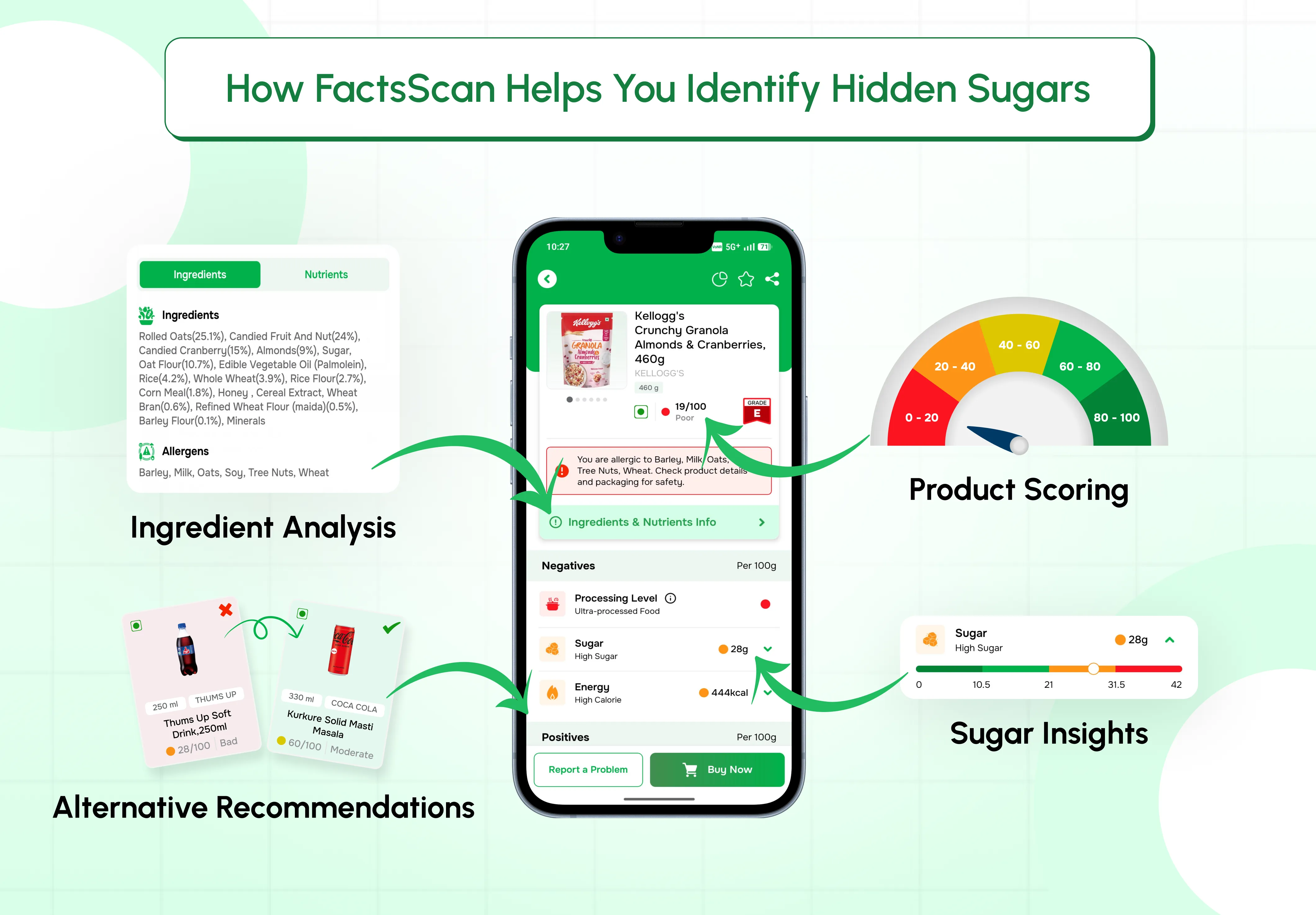
Reading every label manually takes time and requires knowing what to look for. FactsScan simplifies this process instantly.
Here is what FactsScan does when you scan a product:
- Barcode scanning — scan any packaged food in seconds
- Ingredient analysis — automatically identifies added sugars, hidden sugar names, and naturally occurring sugars
- Sugar insights — shows you total sugar content in plain language, not just raw numbers
- Product scoring — each product gets a score based on its full nutritional profile, not just sugar. If you are curious about how that score is calculated, the FactsScan scoring system explains the logic behind it
- Alternative recommendations — suggests healthier options if a product scores poorly
Whether you are managing your weight, supporting a health condition, or simply trying to eat better, FactsScan gives you clear, actionable information and not just a confusing array of label claims.
Conclusion
“No Added Sugar” is a meaningful claim, but it is not a guarantee that a product is low in sugar, low in calories, or suitable for every health goal. It simply means no sugar was introduced during manufacturing. Natural sugars from fruit, milk, and other ingredients can still make a product quite sweet and calorically significant.
Front of pack claims are designed to catch your eye. Ingredient lists and nutrition panels are where the full picture lives. Making it a habit to check both, especially total sugar content and serving size, will serve your health far better than relying on any single label.
Understanding sugar claims is not about fear or avoiding entire food categories. It is about making informed choices that genuinely align with what you want for your health.
Packaged food labels can be confusing, and food companies know it. FactsScan cuts through the noise by scanning any product barcode and instantly breaking down its sugar content, hidden ingredients, and overall nutritional value. You will know exactly what you are buying, what the label really means, and what a healthier alternative looks like.
Download FactsScan today and start shopping with clarity and confidence.
Frequently Asked Questions (FAQs)
"No Added Sugar" means the manufacturer did not add any sugar or sweetening ingredient during the making of the product. However, the product can still contain naturally occurring sugars from ingredients like fruit, milk, or grains.
No. "Sugar Free" means the product contains less than 0.5g of sugar per serving, covering both added and natural sugars. "No Added Sugar" only confirms that no sugar was introduced during manufacturing. A product can be labelled "No Added Sugar" and still contain significant natural sugar.
Yes. Natural sugars present in ingredients like fruit, milk, and vegetables remain in the product. A fruit juice or dried fruit snack bar labelled "No Added Sugar" can still contain 15 to 25g of total sugar per serving.
Not necessarily. Total calorie intake and overall diet quality matter more than any single label claim. Many no added sugar products are still calorie dense. Always check the full nutrition panel rather than relying on front of pack claims.
Yes. Honey is classified as an added sugar by nutritional guidelines because it is added to a product to increase sweetness. A product containing honey cannot carry a "No Added Sugar" claim.
Fruit naturally contains fructose. When fruit is juiced, the fibre and pulp are largely removed, but the sugar remains. A 250ml glass of pure orange juice can contain around 20 to 25g of sugar, entirely from the fruit itself, with nothing added.
Check the ingredient list for names like maltose, dextrose, corn syrup, fruit concentrate, evaporated cane juice, and barley malt. Then check the nutrition panel for total sugar per 100g and per serving. FactsScan can identify these names automatically when you scan a product.
People managing diabetes should not assume "No Added Sugar" products are automatically safe. Total carbohydrate and total sugar content are what matter most. Always check the nutrition panel and consult a registered dietitian or doctor for personalised guidance.
Ready to make Healthier Choices?
Download FactsScan now from the Google Play Store and App Store and take charge of your food choices.





Sweety Patel

Author

Sweety Patel, founder of FactsScan, has over 14 years of experience in the development industry, where she has successfully created multiple applications. Driven by her passion for food safety and health, she launched FactsScan to provide consumers with a reliable solution to understand what they’re eating, its nutritional value, and better alternatives. With extensive research in food and nutrition, Sweety is committed to empowering people to make informed food choices for a healthier lifestyle.
Recent Articles

You Trust the Brand. But Have You Actually Read the Label?
What surveys and real data reveal about how Indian consumers actually shop, and why a trusted logo on the front is not the same as knowing what is inside.
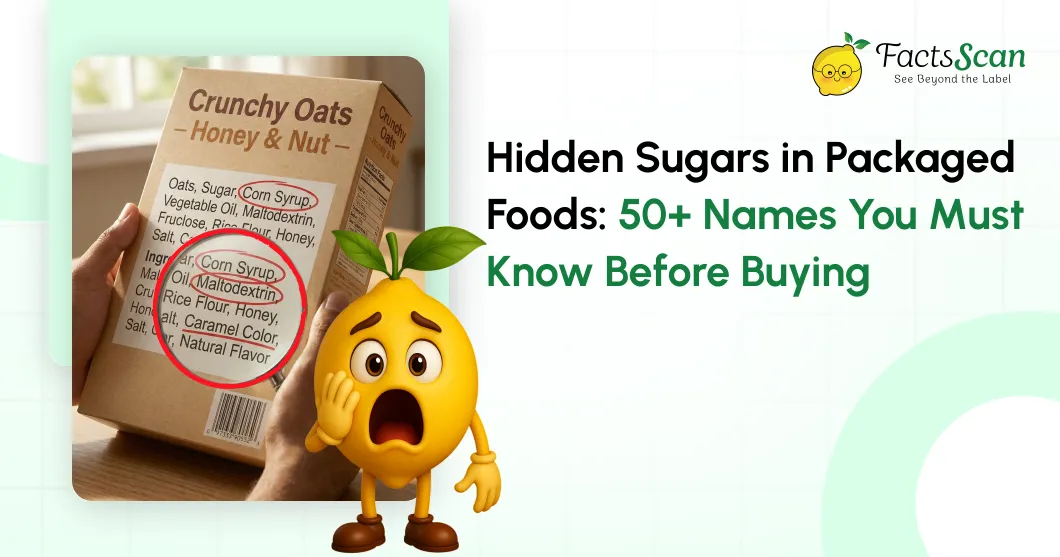
Hidden Sugars in Packaged Foods: 50+ Names You Must Know Before Buying
Uncover the shocking truth about hidden sugars lurking in everyday packaged foods. Learn why manufacturers add them, understand the serious health risks, and master the skill of identifying over 50 disguised sugar names on ingredient labels to protect your health.
Top Food Ingredients You Should Avoid for Better Gut Health
Your gut microbiome is the foundation of your overall wellness, affecting everything from digestion to immune function. Yet many everyday food ingredients—artificial sweeteners, refined oils, emulsifiers, and preservatives—are slowly damaging this delicate ecosystem. Learn which harmful ingredients to eliminate from your diet and discover healthier alternatives using smart tools to identify nutritious, gut-friendly options that truly support your digestive health and long-term wellbeing.